.png)
.png)
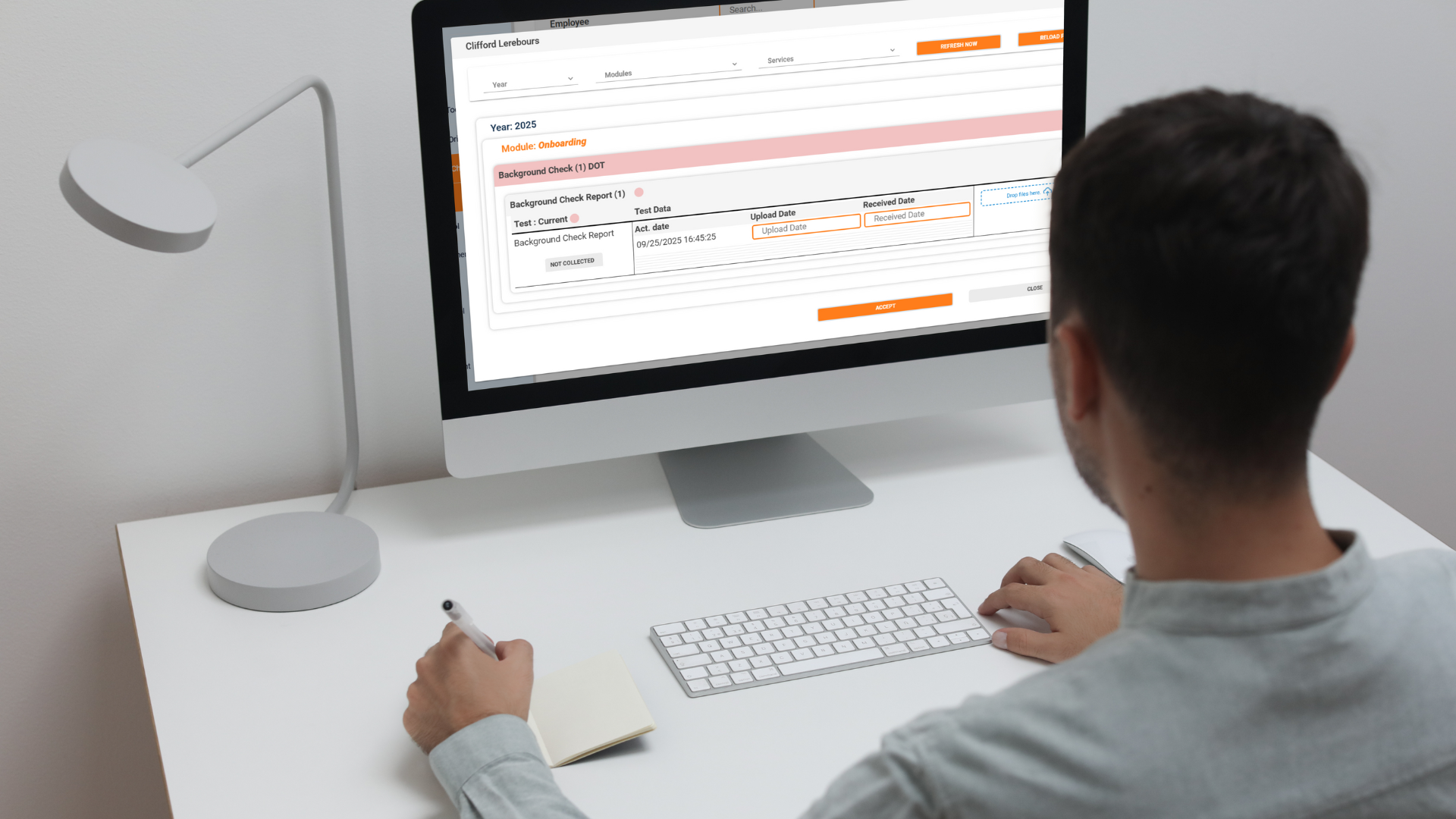
In safety-sensitive operations, DERs are responsible for decisions and documentation that must stand up under scrutiny and hold together during high-pressure events.
And the role is explicitly high-stakes: under DOT rules, a DER is authorized to take immediate action to remove employees from safety-sensitive duties and to make required decisions in the testing and evaluation process—and service agents can’t act as the DER.
So if your program still relies on spreadsheets, inbox searches, and scattered shared drives, that “2:00 AM worry” makes sense: not because your team isn’t capable, but because manual systems are fragile by design.
Nexus exists to make the program repeatable, provable, and audit-ready by default—across the DOT procedural rule (49 CFR Part 40) and agency-specific requirements (like FAA Part 120, FTA Part 655, FRA Part 219).
The high stakes of compliance
A DOT-regulated drug and alcohol testing program isn’t just “running tests.” It’s maintaining a defensible process: correct steps, correct documentation, correct access controls, and the ability to produce proof quickly.
Part 40 establishes the DOT-wide procedures for how testing is conducted, who does what, and what documentation must exist to support decisions.
That’s why compliance leaders need to move away from the “old way” of manual spreadsheets + email threads + shared folders. Those tools weren’t built for audit trails, chain-of-custody organization, or consistent workflows across locations—especially when you need answers fast.
Where manual programs break
Manual program management creates predictable failure points:
- Version confusion and missing artifacts: multiple “sources of truth” means missing signatures, incomplete records, and inconsistent file naming.
- Administrative drag: DERs spend hours each week on status checks, reminders, and repetitive data entry instead of program oversight.
- Low visibility across sites: it’s hard to know what’s done, what’s late, and what’s stalled across depots, terminals, or business units.
- Audit anxiety: when documentation lives in too many places, audits become a scramble.
If you’ve ever had to rebuild a timeline from email timestamps, you already know: the risk isn’t just noncompliance—it’s non-defensibility.
What DERs should demand from a modern program platform
The “must-haves” for any system supporting a regulated program:
- Centralized records + structured organization: employee, case/event, vendor, outcome.
- Role-based access controls: so the right people can act, and the wrong people can’t.
- Workflow standardization: for core event types (random, post-accident, reasonable suspicion).
- Audit trail visibility: what happened, when, by whom.
- MIS-ready reporting: because annual reporting isn’t optional for many employers.
DOT annual testing data reporting is governed by the relevant modal agency, and March 15 is a key submission deadline in multiple contexts (including FAA annual reports and DOT MIS guidance).
Why Nexus: four pillars built for DER reality
Pillar 1: Automation that gives DERs their week back
Nexus reduces repetitive admin work by automating the tasks that typically consume DER capacity:
- Standardized workflows for core event types
- Tasking/reminders so cases don’t stall
- Cleaner handoffs across stakeholders (HR, safety, supervisors)
The goal is straightforward: fewer “manual touchpoints,” fewer dropped steps.
Pillar 2: Permanent audit readiness
Nexus centralizes documentation and preserves the proof behind your process—so audit readiness becomes a state of operation, not a quarterly fire drill.
This pillar is especially relevant because DOT program compliance isn’t just “having a policy”—it’s being able to produce the records that demonstrate the policy was followed under Part 40 procedures.
What “audit-ready” looks like in practice:
- A single, searchable system of record
- Role-based access to protect sensitive documentation
- A defensible activity trail of actions and updates
Pillar 3: Built for experts, not generic HR software
DER work is operational. It’s time-sensitive. It spans multiple vendors and stakeholders. And it often happens under pressure (post-incident, last-minute removals, fast documentation requests).
Nexus is fully customizable and designed around DERs specific workflows so the system supports work as it actually happens.
Pillar 4: Proactive risk mitigation with AI assistance
The best compliance outcomes happen before a gap becomes an exposure.
Nexus uses AI-enabled checks to help identify exceptions early (missing artifacts, stalled steps, inconsistent inputs), so the DER can act while the issue is still small and fixable.
Cross-industry versatility: one platform, multiple regulatory contexts
Nexus is used across safety-sensitive industries because Part 40 procedures and annual reporting expectations create common operational needs—even when modal requirements differ.
A quick snapshot:
|
Industry |
Common Compliance Focus |
|
Aviation / Aerospace |
FAA program requirements (Part 120) + DOT Part 40 procedures; annual reporting obligations |
|
Mass Transit |
FTA testing program requirements (Part 655) and annual MIS summaries/reporting expectations |
|
Railroads |
FRA testing requirements (Part 219) with program documentation built for inspection and oversight |
|
Logistics / Fleet |
Multi-location oversight, vendor coordination, record integrity (often plus FMCSA program needs) |
|
Construction / Utilities |
Subcontractor oversight, credential verification, cross-department readiness |
MIS reporting: where programs often feel the most pain
Annual reporting is one of the most common “stress points” in a DER’s calendar because it forces you to consolidate a year’s worth of activity into a standardized format.
Two key anchors worth knowing:
- DOT’s MIS reporting guidance emphasizes annual submissions (by modal requirement) and highlights March 15 as the submission deadline in many cases.
- The MIS data collection form is standardized in Appendix J to Part 40.
For aviation specifically, FAA rules require annual testing reports submitted by March 15 of the succeeding calendar year.
Nexus helps by automatically populating your reports, making year-end reporting a controlled process, not a cleanup project.
Collaborative compliance
In distributed organizations, the most common breakdown isn’t expertise—it’s fragmentation.
Nexus is built so authorized stakeholders can operate from the same live status view:
- Accountability: supervisors and leaders can see what’s complete vs. pending across sites
- Vendor coordination: documentation and updates can be attached to the correct record without inbox archaeology
- Defensibility: actions and updates are attributable (who did what and when)
- Dashboard Reporting: Organization-wide dashboard charts allow for quick visualization of your workforce results.
Moving from reactive to strategic
If your program depends on spreadsheets, it’s reactive by default. You’re always one missing file away from an escalation, and annual reporting becomes a scramble.
Nexus helps DERs and compliance leaders shift to a repeatable, provable operating model—with centralized records, standardized workflows, and proactive exception handling—so compliance supports the mission instead of interrupting it.
If you’re ready to stop managing compliance like a paper chase, schedule a demo to see the DER workflows and dashboard in action.